AI Is Not the Risk. Our Decisions Are.
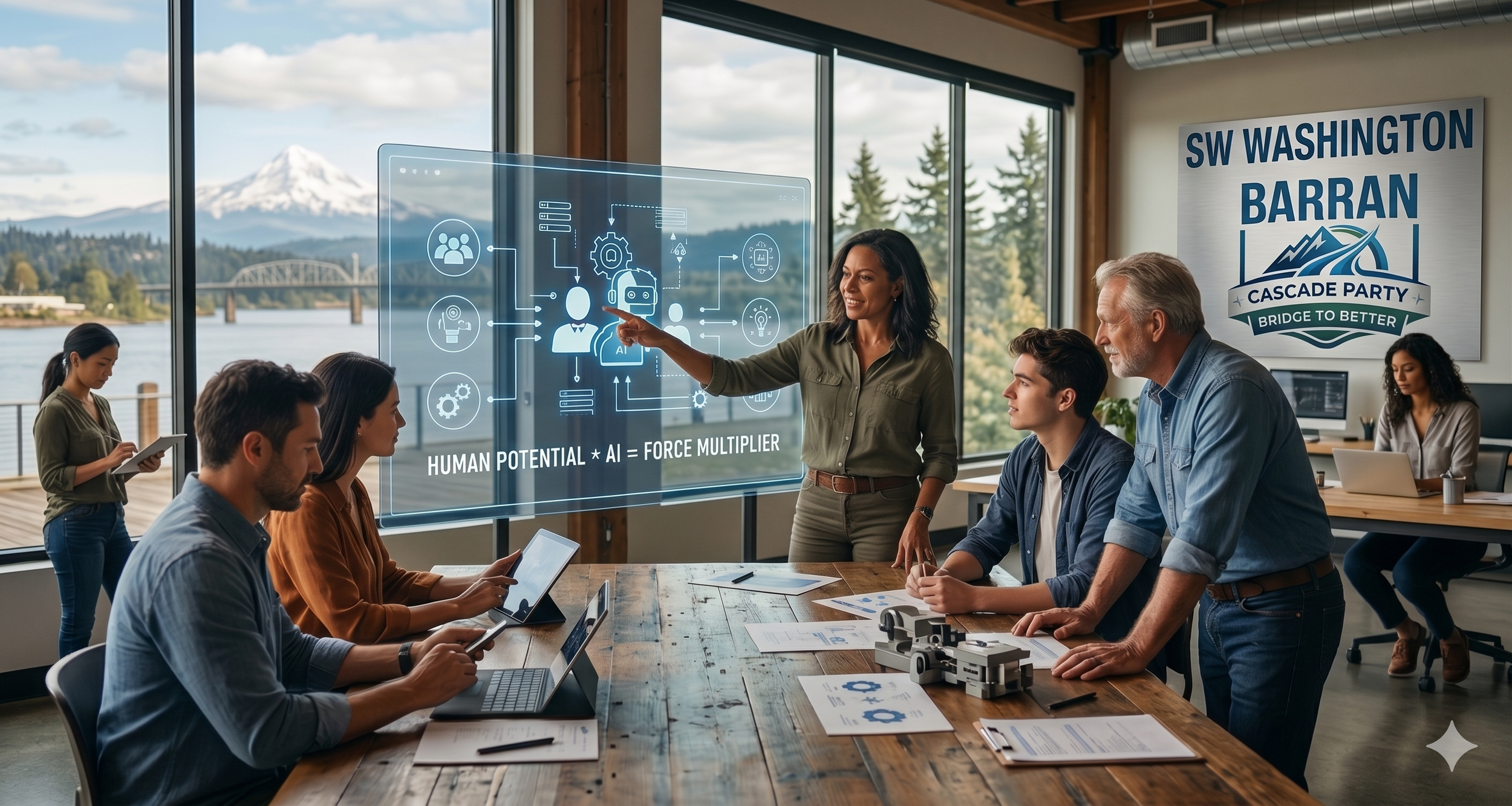
What happens next in the AI economy is a choice
We run a boutique brand and ecommerce marketing agency with a limited, curated set of clients. Sixteen months ago we started to see our clients’ traffic “wobble.” Not drop in a dramatic way, just wobble. Enough to notice. Enough to trigger that instinct that something underneath the surface was shifting.
It set our spidey senses off, and we began to investigate.
What we realized was that the introduction of AI into the world of the internet was changing how traffic moved around it. Quietly at first. Not in a way that showed up in headlines or quarterly reports, but in patterns. In how queries were being answered. In how discovery was happening. In what was no longer being clicked.
So we did what we have always done when something fundamental shifts. We leaned in.
We invested both time and capital into understanding how AI actually works. Not at a theoretical level. At an operational level. How it ingests information. How it prioritizes sources. How it determines what is credible, what is useful, what is worth surfacing. And then we asked the more important question. If this is how information is going to be processed going forward, how do we need to change the way we operate?
What resulted was beyond anything we could have imagined.
We did not bolt AI onto our existing process. We rebuilt the process.
We began developing AI agents that could take on very specific roles inside the business. Some focused on ingesting and structuring large data sets. Others focused on analysis. Others on pattern recognition. Others on translating that output into something usable. What had historically required layers of manual effort and time started to compress. Not disappear, but compress in a way that fundamentally changed the speed and depth at which we could operate.
And what happened next was the part no one is really talking about.
We did not need fewer people.
We became dramatically more capable.
The constraint was no longer time or access to information. The constraint became how far we were willing to push our own thinking. We could go deeper into a problem. We could test more hypotheses. We could see connections across data sets that previously lived in isolation. We could produce work that was not just faster, but materially better.
It set us free in a way I never could have imagined.
Not free from work. Free to do the work that actually matters.
Thirty five years of experience working with complex businesses, understanding how brands behave, how consumers make decisions, how markets shift, all of that became more valuable, not less. AI did not replace judgment. It increased the return on it.
That is why I struggle with the way this conversation is currently being framed.
There is an assumption embedded in much of the public discussion that AI is going to replace jobs. That it is, at its core, a labor reduction tool built for efficiency. That may happen in some cases. It already is in some narrow applications. But that is not the full picture, and more importantly, it is not the only path.
AI is going to take over tasks. That is undeniable. In many cases, it should. There are parts of most jobs that are repetitive, mechanical, or constrained by process. Removing those elements does not eliminate the job. It changes the composition of it.
What happens next depends entirely on how leaders interpret that change.
If you look at AI and see cost savings, you will use it to reduce headcount. You will capture the efficiency gain in your margins. You will narrow the scope of roles and, over time, you will likely find yourself with a smaller, more fragile organization that is highly efficient and increasingly constrained in its ability to adapt.
If you look at AI and see it as an opportunity to be a force multiplier, the outcome is very different.
You start asking different questions. If one person can now do significantly more, what could a team of those people build? What problems that were previously too complex or too time consuming can now be tackled? What new products, services, or capabilities become possible when the friction is removed?
That is the path we chose.
We did not ask how many people we could eliminate. We asked how far we could push.
And the answer, at least so far, is further than we expected.
This is not an abstract policy debate. It is a set of decisions that are being made every day inside businesses. Quietly. Without fanfare. And those decisions will aggregate into an outcome that either expands opportunity or compresses it.
For a region like Southwest Washington, this matters more than most people realize.
We are not a place that can afford to get caught flat-footed in a structural shift like this. At the same time, we are not starting from behind. We are a region built on productivity, on making things work with limited resources, on solving real problems in real environments. That mindset translates exceptionally well to a world where AI is a tool, not a crutch.
But this does not happen on its own.
If we want AI to be a force multiplier for people rather than a cost-cutting tool that leads to job loss, we need to be intentional about how we build around it.
That means alignment.
From elected officials, to regional organizations like the Pacific Mountain Workforce Development Council and WorkSource Washington, through our education system, and directly into the business community.
We need to build the infrastructure that supports this shift.
Access to tools. Practical training. Real-world application. Not theory. Not reports that assume a static economy, but dynamic systems that prepare people for where the puck is going, not where it has been.
If we do that, this becomes an expansion.
If we do not, it becomes another missed opportunity.
That is what this campaign is about.
Building a bridge to better.
Not by resisting change, but by shaping it.
Because AI will multiply whatever we put into it.
The only real question is whether we choose to multiply opportunity, or job loss.